 |
|
The immediate threat of mutual assured destruction (MAD) from a U.S.-Russian nuclear war may now be behind us. But ahead of us there is a brave new nuclear world whose awesome
The material is plutonium, a manmade element that is an essential ingredient of nuclear weapons. It is created in civilian reactors that generate electricity for cities. Originally, plutonium was made in military reactors, first developed by the United States during World War II and used in the Nagasaki bomb. Today, military reactors are confined to a relatively few nations---the five original nuclear-weapons states (the United States, Russia, England, France and China) and the three other states known to have nuclear weapons (India, Pakistan and Israel). Nuclear power reactors were first built in the 1950s, and today they are found in over 30 countries. Although the intended use of these two kinds of reactors is different, the problem is that they both produce plutonium, a byproduct of nuclear fission. Civilian electrical power reactors are typically much larger than military production reactors and therefore produce many times more plutonium than military reactors. The nuclear power industry is about to introduce civilian plutonium on a massive scale on the world market as a commercial fuel. The uranium now used in power reactors is a low grade uranium that cannot be used in weapons. But the plutonium can be used either for fuel or for bombs. Plutonium becomes a concentrated nuclear-explosive material once it is separated from the highly radioactive spent fuel of a reactor. This processing of reactor wastes to recover plutonium is called "reprocessing." If plutonium is then mixed with uranium, the so-called "mixed-oxide" (MOX) fuel can be used to run reactors. This is the industry's plan. It has begun producing by the ton a material that can be used by the pound to make nuclear weapons. The design of atomic bombs is now within the reach of nations as well as terrorist groups. All they need to complete the job is plutonium. A further problem is the continuing use of bomb-grade, highly enriched uranium (HEU) in research reactors on university campuses and in research institutes, where security is typically relaxed. International trade in HEU was started with little foresight in the 1950s, under the Atoms for Peace program. Over the next three decades, the United States exported dozens of nuclear research reactors and tens of tons of HEU---the same material used in the Hiroshima bomb. If stolen or diverted, a tiny fraction of this material---less than 50 pounds (25 kilograms) ---is sufficient to build a nuclear weapon. Commerce in bomb-grade uranium is especially dangerous because of the relative ease with which it can be made into nuclear weapons. Iraq had begun to divert its research-reactor uranium to bombmaking until interrupted by the Gulf War. The brave new nuclear world that lies ahead is actually at a crossroads. One path leads to widespread use of plutonium and bomb-grade uranium as civilian fuels on the premise that they can be adequately protected against misuse for bombs by nations or by groups. The other path leads to a ban on these fuels because 100% protection and permanent peaceful use cannot be guaranteed. Both paths are still open. Power and research reactors can be operated efficiently, safely and securely on low-grade uranium that cannot be used in bombs. Pursuing innovative and effective ways to achieve this goal and to prevent the further spread of nuclear weapons is the work of the Nuclear Control Institute.
For more details, see "The Plutonium Threat" |
 decade after the end of the Cold War and a half-century beyond the dropping of the atomic bombs of World War II,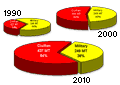
 |
 |
 |
 |
 |
 |
 |
 |
 |
 |
 |
 |
 |
 |
 |